Motaben is a lady with a disarming smile and a warm, inviting presence. She addresses you as “Monae” or “Molae,” and places a request so gently that refusal rarely comes to mind.
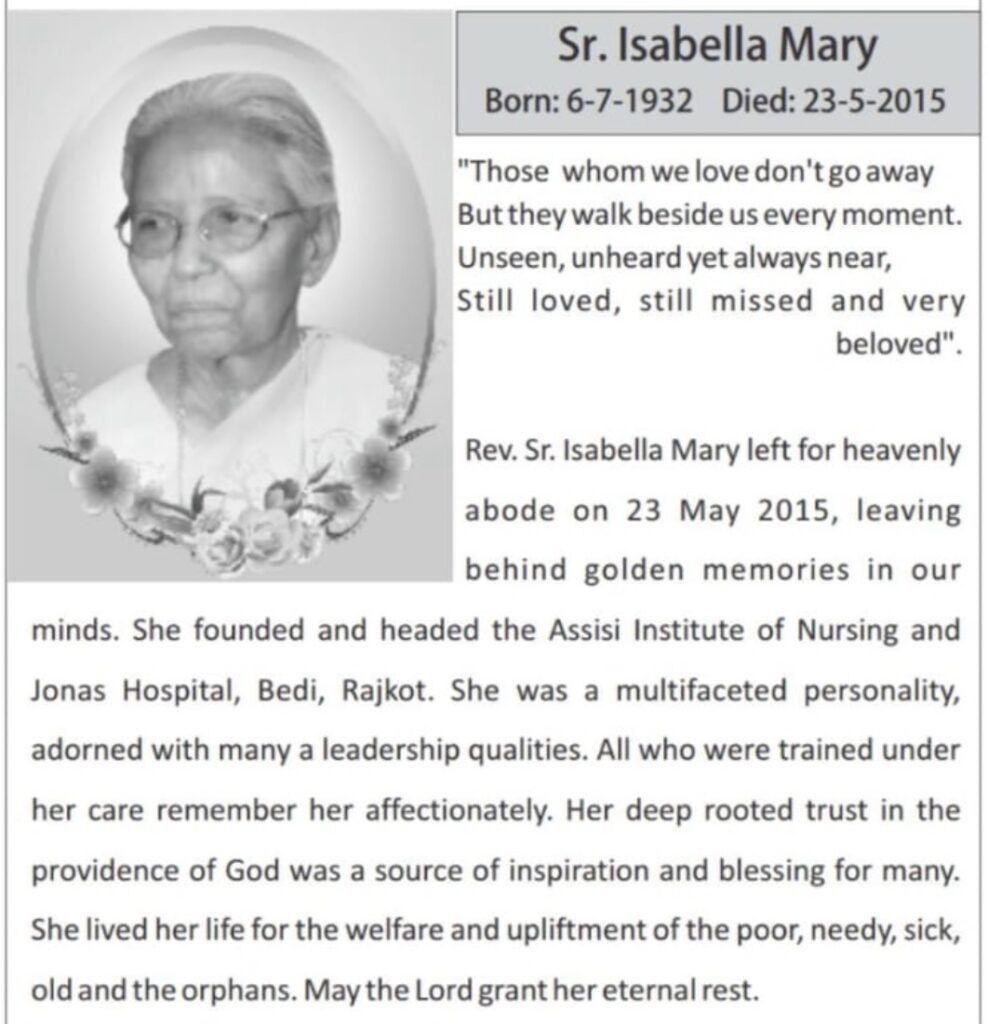
“I now welcome to the stage – Sr. Isabella Mary, Amma’s sister, our Aunty, and the children’s Kochammama – a lady with an indomitable spirit and a never-say-die attitude. Please give her a standing ovation.”
Sr. Isabella held a special place in our hearts. We spoke of her with pride and reverence. There was something about her—you found yourself setting work aside just to be near her when she called.
That perhaps explains why, on a day in 1981, I was travelling with her on the Dadar–Madras Express to Bangalore, in an unreserved compartment. Aunty had a habit of travelling at short notice. There was always a reason—as though guided from above.
The train pulled out. The platform noise faded. Hawkers moved in, urging us to buy something for “time pass.”
Then came something unusual.
A group of salesmen began conducting an “auction.” The highest bidder would get the item—but everyone would receive a gift.
No one bid seriously. Yet gifts flowed—combs, then wallets.
Then the tone changed.
“Do you really have money to bid,” one of them challenged, “or are you here just for the gifts?”
They demanded proof. Each participant was asked to place ₹105 into the wallets they had received.
Reluctantly, they complied.
All except one man—a middle-aged passenger on the upper berth, wearing a skullcap.
He refused.
In an instant, the mood turned menacing. One man grabbed him by the collar. Another pulled out a knife.
The compartment fell silent.
Except for one voice.
“Leave him. Let him go. You will hurt him,” Aunty pleaded.
“Mind your business!” came the reply.
But she did not stop.
I was frightened. I asked her to keep quiet. She did not.
She kept speaking. Kept intervening. Kept distracting them.
Then the man calmly declared he was a Mumbaikar and knew their tricks.
Something shifted. The goons backed off.
Minutes later, they dumped cheap utensils on the passengers, pulled the chain, and jumped off before Kalyan.
Normalcy returned.
The passengers inspected the utensils—with magnets. They had been duped.
Later, Aunty explained simply:
“I could do what I did because of my vocation. I don’t have to worry about a dependent family.”
I disagreed.
What I witnessed was not circumstance. It was courage—the ability to act despite fear, and to stand up for a stranger.
Motaben—that is how she is lovingly known at the Anganwadi.
Let us pause—and offer a quiet prayer for someone so deeply loved and revered.